
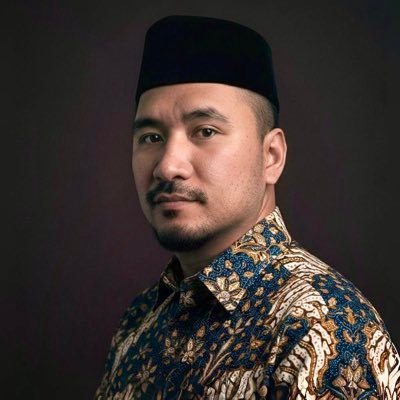
Jauhari Johar is a Malaysian political activist, writer, and music producer who advocates for Malay culture and Islamic governance. He is the author of the book The Malay Agenda: How to Defend Malay Power and Islamic Sovereignty in the 21st Century (2025).
Early Life and Career
Jauhari Johar (full name: Ardiv Jauhari bin Johar) was born on January 16, 1989, in Melaka, a state rich in Malay and Islamic history. He was raised in Petaling Jaya, Selangor, where he was exposed to a diverse multicultural urban environment.
Coming from an influential artistic family, he received guidance from his father, Johari Teh, a respected figure in the Malaysian music industry. Jauhari pursued his studies at Universiti Teknologi MARA (UiTM) and earned a Diploma in Music.
Known professionally as Ardiv Jauhari, he worked as a music producer and composer, collaborating with popular artists such as Amy Mastura, Alyah, Eka Sharif, Zamani and Projector Band. Among his notable works are:
- Istilah Syawal (Alyah)
- Aisyah (Projector Band)
- Sedar (Iqmal Haziq)
His musical output often blends traditional Malay elements with contemporary sounds, reflecting his deep appreciation for Malay culture, a sentiment that later became the foundation of his activism.
Innovation in AI Music
Besides traditional music production, Jauhari is a pioneer in AI music technology application through his YouTube channel, “Jauhari Music“. As one of the first in the region to do this, he uses the platform to experiment with Artificial Intelligence (AI), giving traditional and classic Malay music a contemporary presentation for modern listeners.
Additionally, Jauhari uses AI tools to write his own music by mixing AI-generated melodies and textures with his own original songs and lyrics. This work connects Malay cultural arts with modern technology. It shows his belief that Malay cultural identity can remain strong and competitive through new digital innovations.
Political Activism
The 15th General Election (GE15) in 2022 served as a turning point in his career. The decline of UMNO and its subsequent cooperation with the more liberal coalition, Pakatan Harapan, concerned him, as he believed it weakened Malay-Muslim values and opened the door to stronger liberal and secular influences.
This development prompted him to focus on Malay-Muslim political awareness. Through platforms such as X (Twitter), TikTok, and long-form writing, Jauhari built a reputation as a voice capable of translating grassroots anxieties into structured political ideas.
His activism emphasizes the need for modern reforms for Malay-Muslim values while still acknowledging the reality of Malaysia’s pluralistic society.
Advocacy for the Malay Language
Jauhari is a staunch defender of the Malay language as the national language of unity. In March 2024, he expressed agreement with Ridhuan Tee’s view that the proficiency of the Malay language in Chinese vernacular schools (SJKC) was not on par with national schools. He urged the Chinese community to re-evaluate the role of vernacular schools, sparking a nationwide debate.
In May 2024, he further asserted that graduates of national schools are better suited to be political leaders compared to those from vernacular streams, arguing that representatives must be fluent in the Malay language to effectively serve the Malaysian electorate.
Political Manifesto
In 2025, Jauhari published a seminal work titled The Malay Agenda: How to Defend Malay Power and Islamic Sovereignty in the 21st Century. The book serves as a policy framework proposing a restructuring of Malaysia’s political and economic systems through four primary focus areas:
1. Strengthening the Economy via the Halal Industry
Jauhari advocates for a shift from a subsidy-dependent economic model toward market dominance driven by the halal industry. He emphasizes:
- Leveraging the food, tourism, cosmetics, and pharmaceutical sectors to achieve national export targets.
- Aligning economic policies with global standards to enhance the international competitiveness of Bumiputera-owned companies.
2. Standardization of the Education System and Language
Regarding education, he argues for the empowerment of national identity through:
- Elevating Bahasa Melayu as the primary medium of instruction in both the education system and the corporate sector to bridge economic disparities.
- Proposing a single-stream school system, where other mother tongues are retained as elective subjects to foster social integration.
3. Technological Integration and Islamic Modernity
Jauhari stresses the importance of digital literacy in constructing a contemporary Islamic image. His focus includes:
- Utilizing technology and digital media as platforms to propagate Islamic values based on a blend of conservative and progressive elements.
- Efforts to curb extremist narratives from both the left and right by mastering AI technology, social media platforms, and algorithms.
4. Governance and Leadership
He outlines the necessity for leadership that meets two specific criteria:
- A combination of profound foundational Islamic understanding and technical expertise (technocracy).
- A commitment to transparency in administrative duties and a firm stance against corruption as core principles to safeguard national sovereignty.
Overall, Jauhari argues that this approach represents a nation-building model that harmonizes Islamic principles with modern requirements, aiming to secure Malaysia’s long-term political and economic stability.
Publications
- The Malay Agenda: How to Defend Malay Power and Islamic Sovereignty in the 21st Century (2025) A strategic policy framework proposing the strengthening of Malay political and economic power through the “Halal Sovereignty” model and technocratic leadership rooted in Islamic values.
- Why Vernacular Schools Divide Us: The Threat to Unity and National Identity (2025) A provocative work analyzing the impact of the vernacular school system (SJKC/SJKT) on national integration.
Media Coverage
- Focus Malaysia reported that Jauhari’s statements regarding vernacular schools frequently spark debates on social media, garnering diverse reactions from the public.
- Sovereign Magazine featured his book in 2025, highlighting the concept of a Shariah-compliant economy (halal economy) as a vital component of Malaysia’s future development.
References
- “All discography by Ardiv Jauhari”. Diskograf. Retrieved 2025-09-14.
- Alhamzah, Tahir (2017-01-22). “(Showbiz) It’s been awhile, Amy Mastura | New Straits Times”. NST Online. Retrieved 2025-09-14.
- Chua, Dennis (2016-09-11). “Rising above failure | New Straits Times”. NST Online. Retrieved 2025-09-14.
- “Istilah Syawal (2014) by Alyah”. Diskograf. Retrieved 2025-09-14.
- Aisyah by Projector Band on Apple Music, 2017-05-12, retrieved 2025-09-14
- “Sedar – Iqmal Haziq: Song Lyrics, Music Videos & Concerts”. Shazam. Retrieved 2025-09-14.
- FocusM (2024-03-17). “Netizens defending SJKC’s proficiency in teaching Bahasa Malaysia”. Retrieved 2025-09-14.
- FocusM (2024-05-05). “Do national school leavers make better political leaders than their vernacular school peers?”. Retrieved 2025-09-14.
- Magazine, Sovereign (2025-05-12). “Islamic Economic Leadership Reshapes Malaysia’s Growth Strategy – Sovereign Magazine”. http://www.sovereignmagazine.com. Retrieved 2025-09-14.
 Jauhari Johar Official